
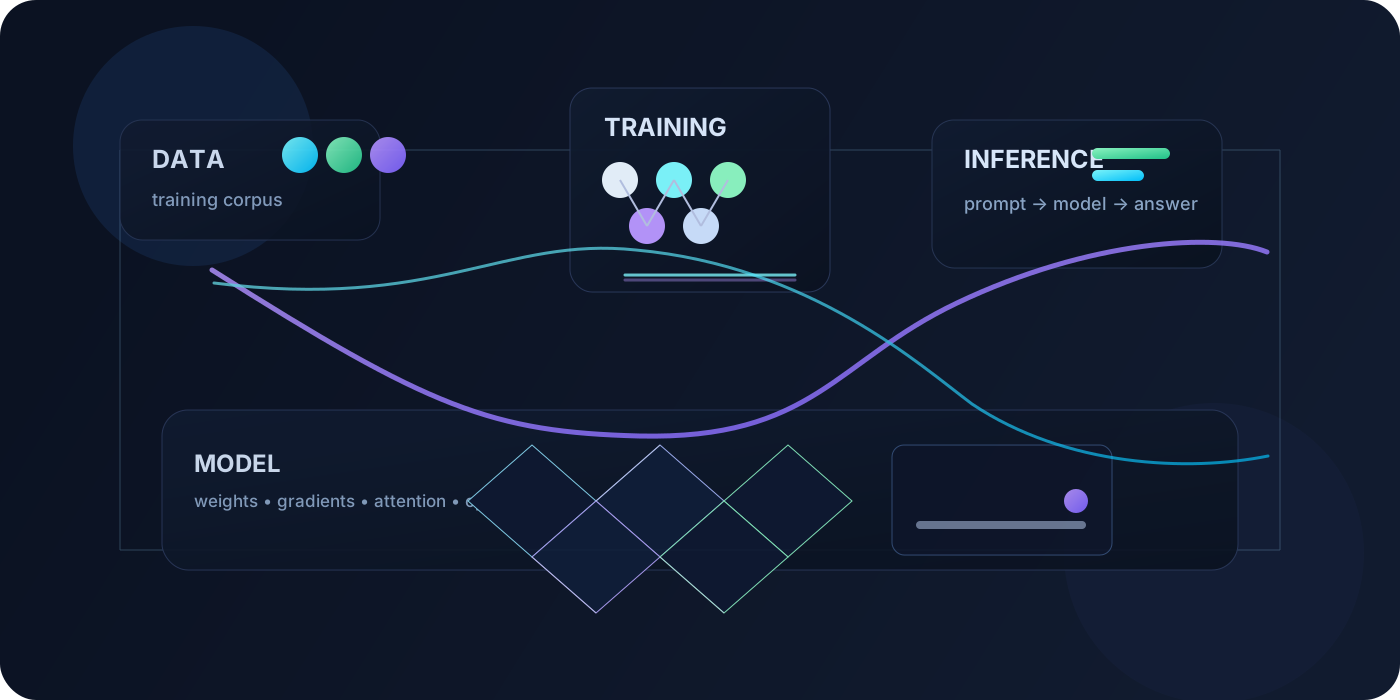
AI is a broad term, but most people mean a system that learns patterns from examples and then uses those patterns to make useful predictions or generate output. A model is not a mysterious brain. It is a parameterised function: data goes in, many mathematical operations happen, and a result comes out.
That is why the best explanation is not “AI thinks like a person.” It is better to say: AI learns statistical relationships from data, then applies them under constraints. That is useful because it helps us understand both the power and the limitations.
What AI actually is
At a practical level, AI includes several layers:
- Traditional machine learning: models such as decision trees, random forests, and gradient-boosted machines learn from structured data.
- Deep learning: neural networks with many layers learn features automatically from raw data such as text, images, audio and video.
- Generative AI: models that create text, code, images, music or audio by predicting the next token or pixel pattern.
- Agentic AI: systems that combine models, tools and workflows to perform multi-step tasks.
The common thread is that all of them learn from examples. The model is adjusted repeatedly until it is better at matching the patterns in the training data. Once trained, it can produce outputs for new inputs it has not seen before.
The most important idea is this: the model does not “know” a fact in the human sense. It learns a distribution of likely patterns. That is why it can be brilliant in some settings and confidently wrong in others.
How models are trained
Training is the process of teaching a model by showing it large amounts of data and adjusting its internal parameters until its outputs get closer to the target behaviour.
1. Gather and prepare data
Good data is the foundation. Training starts with collecting data that reflects the task you want the model to do. That might include:
- labelled examples for classification or regression
- text and code corpora for language models
- image and video datasets for vision models
- audio recordings for speech recognition and generation
- user interaction logs for recommendation or ranking systems
The data then gets cleaned, shuffled, deduplicated and formatted. Label errors, duplicated rows, bias, offensive content and missing values all affect the end result.
2. Choose the model architecture
The architecture defines the structure of the computation. For example:
- transformer models dominate modern language and multimodal AI
- convolutional networks remain strong for vision tasks
- recurrent networks used to be common for sequence tasks
- mixture-of-experts and retrieval-augmented designs are used for scale and efficiency
The architecture is chosen based on the task, the quality and scale of data, the latency budget and the hardware available.
3. Define the loss function
The model needs a way to measure “how wrong” it is. This is the loss function. For example:
- classification: cross-entropy
- regression: mean squared error
- generative models: next-token prediction or diffusion denoising
- ranking models: pairwise or listwise ranking loss
A lower loss means the model’s predictions match its target distribution more closely.
4. Run optimisation
Training works by repeatedly doing two things:
- compute a prediction on a batch of data
- adjust the model’s weights using gradients from the loss function
This is the core of gradient descent. The model tries to move toward a better set of parameters. In large models, this requires distributed training across many GPUs or accelerator cards.
5. Use large-scale infrastructure
Most modern training is not done on a laptop. It is run on clusters with:
- multiple GPUs or AI accelerators
- shared memory or high-bandwidth interconnects
- fast NVMe storage
- high-throughput networking
- careful checkpointing and monitoring
This is where the “AI stack” matters: frameworks, orchestration, data pipelines and observability all make a huge difference.
Tools used for training AI
The tooling depends on whether you are training from scratch, fine-tuning a foundation model or building an ML pipeline.
Frameworks and libraries
- PyTorch: the default choice for research and many production systems; flexible, expressive and very widely supported.
- TensorFlow: still common in enterprise and mobile deployment stacks.
- JAX: popular for research, high-performance numerical workloads and distributed training.
- Hugging Face Transformers: highly practical for foundation models, fine-tuning and model sharing.
- MLflow: model tracking, experiment management and reproducibility.
- Weights & Biases: experiment monitoring and model lineage.
- Ray: distributed training and model serving at scale.
- Kubeflow or Kubernetes clusters: orchestration of jobs, data and GPUs.
Training workflow tools
- Docker and containers for reproducible environments
- vLLM or TensorRT-LLM for efficient model serving
- DeepSpeed and FSDP for memory-efficient distributed training
- NCCL for multi-GPU communication
- checkpointing and rollback systems for long-running jobs
For most teams, the practical path is not always “train from scratch”
Very few teams need to train a frontier model from zero. Most organisations should focus on:
- fine-tuning a strong base model
- using retrieval augmented generation for domain knowledge
- building evaluation sets before deployment
- optimising prompts and context management
- training smaller, targeted models when the task is narrow and the data is good
That is often cheaper, faster and more reliable than building a giant model from the ground up.
What inference means
Inference is the act of using a trained model to produce output on new inputs. It is the “runtime” stage of AI.
When you ask a chatbot a question, a model does the following:
- tokenises your prompt into words or subword pieces
- converts tokens into embeddings
- passes them through the layers of the model
- computes attention and feed-forward operations
- predicts the next token, repeating until it reaches a stopping condition
- decodes the tokens back into human-readable text
For large language models, this is computationally heavy but far lighter than training. Training may take days or weeks on hundreds of GPUs; inference can be served on a handful of accelerators or even a laptop with the right optimisation.
Why inference matters so much
A model can be technically impressive but still fail in production if the inference path is slow, expensive or unreliable. Teams must manage:
- latency
- throughput
- token costs
- memory footprint
- concurrency
- prompt context limits
- output quality
- security controls
That is why inference optimisation is a whole discipline: quantisation, batching, caching, distillation and small-model design are all common practices.
General hardware needs for training and inference
AI hardware is not a single category. The right setup depends on the model size, data volume and deployment target.
Training hardware
For training, the most important metrics are:
- GPU or accelerator memory capacity
- tensor throughput
- interconnect bandwidth between cards
- CPU and RAM for data preprocessing
- NVMe SSD throughput for data ingestion
- network speed for distributed jobs
Typical requirements:
- small models: a few GPUs or a single workstation GPU is enough
- mid-sized fine-tuning: 1–8 high-memory GPUs
- large foundation-model training: dozens to hundreds of accelerators, usually with a high-speed cluster fabric
- enterprise training pipelines: high-end storage, monitoring and job orchestration as well as compute
The big reality is that training cost is dominated by compute, time and power. The “bigger the model, the more expensive the training run” rule usually holds.
Inference hardware
Inference is more diverse:
- cloud GPU instances for large models
- server CPUs for smaller models or orchestration
- edge accelerators for low-latency local AI
- NPUs in laptops and phones for efficient local workloads
- dedicated AI appliances for enterprise deployment
The key trade-off is often between model quality and latency. A larger model may be more capable but slower and more expensive to run.
How AI works on different chip families
Nvidia
Nvidia is the dominant platform for training because it has built a mature ecosystem around CUDA, driver support, libraries and distributed training frameworks. Its Tensor Cores accelerate matrix math, which is central to neural network operations.
Why Nvidia matters:
- strong software ecosystem for AI development
- excellent support for distributed training and inference
- mature tooling for memory management, profiling and scaling
- broad cloud availability across providers
This does not mean it is the only option, but it is the most common default for serious machine learning workloads. Nvidia also benefits from the network stack and training libraries that are deeply integrated with PyTorch and other frameworks.
AMD
AMD has become more relevant as the industry diversified beyond a single vendor. AMD’s AI stack, including ROCm and its GPU line, aims to provide a strong open and competitive alternative, especially where cost, flexibility or ecosystem diversity matters.
AMD strengths include:
- competitive GPU offerings for AI compute
- growing support in Linux-based AI environments
- increasing compatibility with open-source ML tooling
- attractive alternatives for organisations that want more hardware choice
The trade-off is often software maturity and ecosystem breadth. More teams still choose Nvidia because the tooling and training support are more battle-tested at scale.
Qualcomm
Qualcomm focuses on efficient AI at the edge. Its Snapdragon platforms include NPUs designed for mobile and laptop workloads, making them useful for on-device inference, local assistants and privacy-preserving AI.
This is particularly important for:
- phones and laptops
- edge cameras and embedded systems
- low-power local inference
- workloads that need to stay near the user instead of in the cloud
Qualcomm’s strength is efficiency: bringing AI closer to the device can reduce latency and keep sensitive data local. It is usually a better fit for light-to-medium inference than heavy training clusters.
Apple Silicon
Apple’s M-series chips combine CPU, GPU and a Neural Engine with a unified memory design. This is a major architectural advantage for local AI. Models can be run on-device with better power efficiency and less data movement.
Apple’s approach is especially strong for:
- on-device inference
- private, local processing
- latency-sensitive features such as speech, image and coding assistants
- efficient inference on laptops and phones
The trade-off is that Apple’s AI stack is tightly integrated into its own ecosystem, and large-scale distributed training is not where Apple competes most directly. Apple is strong at efficient local intelligence rather than training giant multi-GPU clusters.
Security, boundaries and limitations
This is where AI is still human work, not magic.
Security risks
AI systems create real security issues across the life cycle:
- prompt injection: malicious inputs manipulate a model or tool into performing unintended actions
- data leakage: private documents or secrets may be exposed via prompts or retrieval systems
- model poisoning: bad data can skew training or fine-tuning results
- jailbreaks: users or attackers bypass safety controls
- insecure tool use: agentic systems can call functions with too much authority
- supply-chain risk: compromised model weights, libraries or dependencies can create hidden vulnerabilities
Security needs to be designed in from the start: access control, red-team testing, secure retrieval, output filtering, least privilege and strong monitoring.
Boundaries and limits
AI is powerful, but it has predictable weaknesses:
- hallucination: it can sound confident while being wrong
- shallow reasoning in some cases: it may imitate reasoning without reliable internal consistency
- context limits: there is a finite window for information and memory
- bias from training data: the model reflects the patterns and gaps in that data
- brittle edge cases: a system can work on normal examples and fail spectacularly on rare ones
- adversarial examples: small manipulations can fool classification or detection systems
This is why AI is best thought of as an amplifier for human judgement rather than a replacement for it. The output must still be reviewed, tested and governed.
A practical framework for using AI safely
If you are evaluating AI for a product or internal workflow, use a simple framework:
- define the task and expected failure modes
- separate “tooling” from “control plane” access
- start with a narrow task, not a broad ambition
- use evals and adversarial tests
- monitor drift and model quality in production
- keep humans in the loop for sensitive decisions
- secure the data and the model pipeline
This is the difference between building a useful AI feature and building a fragile system that looks impressive in demos.
The brief version
AI is a system that learns patterns from data and then applies those patterns to new inputs. Training teaches the model its parameters. Inference is the live use of those learned parameters to produce output. Different hardware stacks shape where the work happens: Nvidia dominates large-scale training, AMD gives a competitive alternative, Qualcomm excels at edge AI, and Apple Silicon makes private, efficient on-device inference practical.
The real story is not that AI is magic. It is that AI is a powerful pattern-recognition engine with excellent strengths and very real limitations. The winners are the teams that combine good data, good evaluation, strong security and disciplined human review.
That is what turns AI from a novelty into a useful system.