
AI has become normal enough that the next conversation is no longer “what is AI?” It is “what is AGI, and when is it coming?” That is a useful question, but it is also a dangerous one if we treat it as a single moment when a machine suddenly becomes “fully intelligent.”
The better way to think about AGI is not a magic threshold but a broad shift in capability: a system that can handle a wide range of cognitive work, adapt to new tasks, use tools, maintain context and produce useful output across domains with less custom engineering.
That is a serious change. It is not the same as “a computer that is just like a human brain.” It is more likely to look like a future where general-purpose systems become more capable, more autonomous and more integrated into work — while still lacking true common sense, stable judgment and reliable accountability.
What AGI usually means in practice
There are a few common definitions, and they are not all the same:
- general capability: the model can work across many tasks rather than being narrowly tuned to one domain
- task transfer: it can adapt to new tasks without a full rewrite of the system
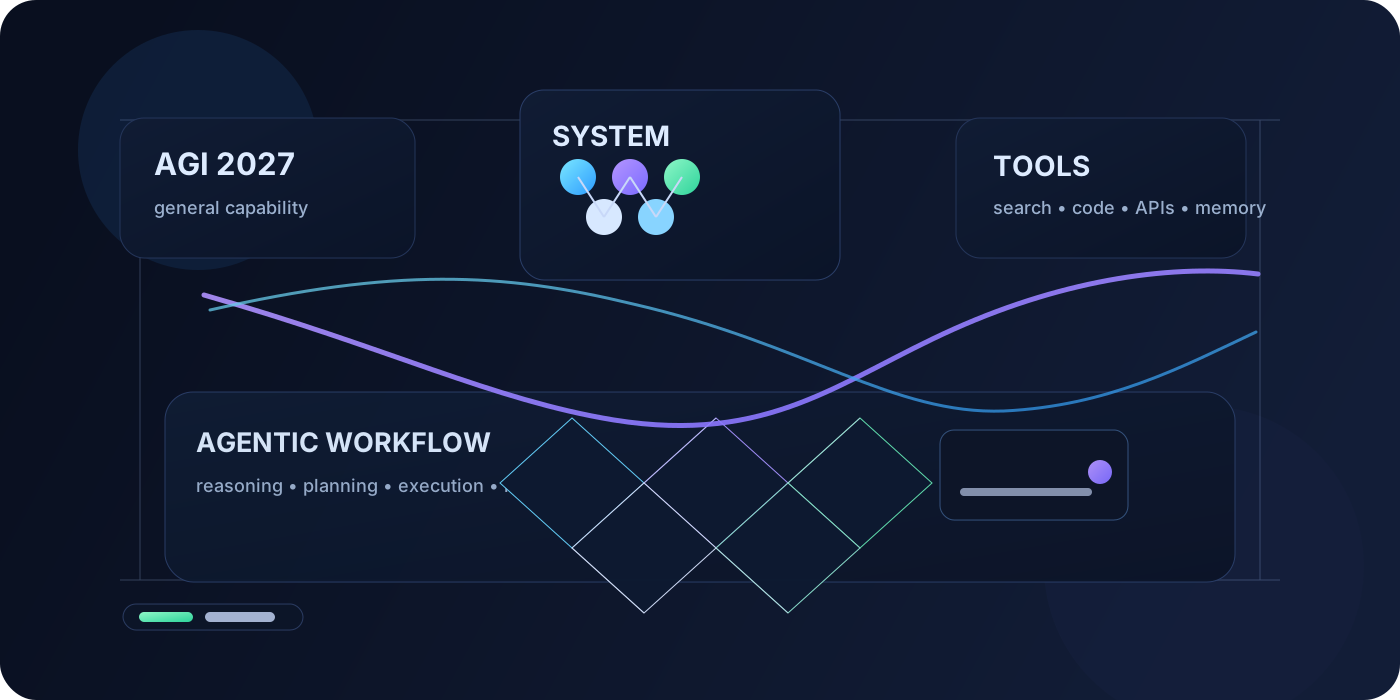
- tool use: it can call APIs, search, write files, reason through workflows and coordinate tasks
- autonomy: it can carry out multi-step work with limited human intervention
- robustness: it can handle unfamiliar inputs, edge cases and change without breaking
The important point is that AGI is usually discussed in terms of breadth, adaptability and autonomy, not just raw output quality.
A model that writes nice code but cannot reason through a sales workflow or a compliance process is not “AGI” in the organisational sense. A system that can move between planning, execution, context gathering and action across many domains is much closer to the kind of capability people mean when they use the term.
What the 2027 signal looks like
By 2027, the likely signal is not a single dramatic moment. It is more likely to look like this:
- AI agents are embedded in work systems rather than isolated in chat windows
- models are connected to structured tools, APIs, retrieval systems and workflows
- memory and context are more durable, allowing a system to operate over longer time horizons
- models begin to do more planning, not just reaction
- evaluation becomes the priority, because the difference between “works in demo” and “works in production” becomes even more obvious
This is where AGI becomes useful: not because it is human-like, but because it can take a task from beginning to end with less custom code and more coordination.
That is also why the conversation is shifting away from “can it answer a question?” and towards “can it complete a chain of work reliably?”
What AGI probably will not mean in 2027
It is easy to get carried away by the story. The more realistic version is that AGI will not arrive as a calm, single-state machine with perfect judgement. The likely reality is a patchwork of capability.
1. It will not be universally reliable
Even a strong general model can fail on:
- edge-case reasoning
- ambiguous instructions
- contradictory requirements
- long-lived context tracking
- hidden system assumptions
- unusual legal or compliance constraints
Good generalisation is not the same as trustworthy decision-making. A model may be good at many things and still be bad at the thing that matters most in a real company: high-stakes judgment.
2. It will not replace human accountability
AGI is not a way around responsibility. If an AI system makes a decision in a hiring workflow, a financial process, an incident response, or a medical support tool, the organisation still owns the discretion, the governance and the consequences.
A system can be very capable and still require review, verification, escalation and legal control.
3. It will not magically understand reality without grounding
Large models can reason from text and patterns at scale, but they do not always have a tight connection to the real environment. They need:
- data pipelines
- retrieval systems
- tools
- sensors
- structured state
- explicit validation rules
Without those, they can perform impressive reasoning at the surface while lacking grounded understanding of what is actually happening.
4. It will not be equally safe or equally useful across organisations
The same model may be a competitive advantage in one environment and a liability in another. Safety depends on how it is connected, what it can access, what it can write, what it can trigger, and what kind of oversight exists around it.
That is why AGI conversations are really about control and governance as much as capability.
The real 2027 architecture: model plus tools plus constraints
What may matter more than AGI alone is the broader system around it. The pattern that is likely to win is not “one huge model doing everything,” but “a model connected to a controlled environment.”
A future AGI-capable workflow will likely include:
- a foundation model with broad reasoning ability
- memory or task state across sessions
- retrieval over internal knowledge and documents
- tool execution via API or command layer
- policy and guardrails before actions are taken
- human review points for important decisions
- orchestration, observability and evaluation loops
This is the architecture that makes large capability usable. Without it, the system is just a smart interface that can produce plausible output without dependable operational value.
Where the risks intensify with AGI-style systems
As generality grows, so do the blast radius and the failure modes.
Prompt injection and adversarial instructions
The more a system interacts with external content, email, documents, browsers and tool calls, the more likely it is to be manipulated. A user or attacker may feed instructions that appear trusted but are actually malicious.
Tool misuse and over-permissioning
This is the real danger in agentic AI. A model can be extremely capable at planning a task and also extremely capable at choosing the wrong tool or overreaching. If the system has write access to production systems, cloud infrastructure or customer records, the risk becomes operational rather than theoretical.
Data exfiltration and privacy leaks
A general system can accidentally connect internal business data to external endpoints, summarise secrets into logs, or retrieve information it should not have access to. That means access control and data boundaries become part of the model design, not a separate afterthought.
Model drift and emergent failure
As systems become more autonomous, small changes in prompt patterns, retrieval quality, data freshness or model versioning can create large downstream changes in behaviour. Monitoring and regression testing become essential.
Human overtrust
One of the greatest risks is not that the system is dangerously stupid. It is that the system feels confident, helpful and clear — and that makes people stop checking. That is where real harm enters.
The boundary between capability and responsibility
This is the vital distinction for 2027: capability alone does not create permission.
A system may be able to do a broad range of tasks, but that does not mean it should be authorised to do all of them.
The right model is to define a hierarchy:
- small tasks: use automation freely within clear boundaries
- medium-risk tasks: require review and logging
- high-risk tasks: require explicit approval, human signoff and fail-safe controls
- autonomous execution: allowed only when the environment is fully constrained and observable
This is not a philosophical argument; it is the edge of a safe deployment model. In real organisations, this is where AI strategy becomes operational risk management.
How to prepare for AGI without pretending it is here already
The most sensible strategy is not to wait for AGI to appear and then respond. It is to build the discipline now that will matter when capability increases.
1. Build evaluation systems
Do not judge AI by one impressive demo. Judge it by:
- task success rate
- failure rate under edge cases
- latency and cost
- tool misfires
- security incidents
- recovery from errors
A good evaluation stack turns vague excitement into operational understanding.
2. Treat tool access as a security boundary
The biggest difference between a “chatbot” and an “agent” is not the model. It is the permission layer. Restrict tools, scope access, log actions and require explicit approval for risky actions.
3. Use human review at the real decision points
The phrase “AI-assisted” should mean exactly that. For sensitive decisions, contract clauses, incident response, financial approvals and customer communications, a human should remain part of the loop.
4. Design for explainability and auditability
Systems that can act broadly need to leave a trail. Logs matter because they answer three questions:
- what was requested
- what did the system do
- why did it decide that
Without that, trust cannot be sustained.
5. Create internal AI policy early
This is not just for compliance. It is a way to define what your organisation intends to delegate, what it will never delegate and what still requires human judgement.
The most realistic AGI story for 2027
The most likely AGI story for 2027 is not “we built a machine that thinks like a person.” It is stronger and more nuanced than that:
- systems become much better at broad reasoning and planning
- they operate across more tasks with less custom work
- they work inside real workflows and toolchains
- they create new productivity gains, but also new failure modes
- organisations need stronger operational controls, not just better prompts
That makes 2027 a year of system design more than a year of philosophical revelation.
The companies that win will not be the ones that simply adopt “AGI.” They will be the ones that design AI systems that are useful, constrained, observable and accountable.
The short version
AGI in 2027 is unlikely to arrive as a single clean milestone. It is more likely to arrive as a threshold in how broadly and autonomously systems can operate, especially when they are integrated with tools, memory and workflow infrastructure.
The real challenge is not whether the model is “smart enough.” It is whether the organisation can govern it safely, keep it bounded and use it without pretending it is a replacement for judgement.
That is the difference between a powerful tool and an uncontrollable risk.