
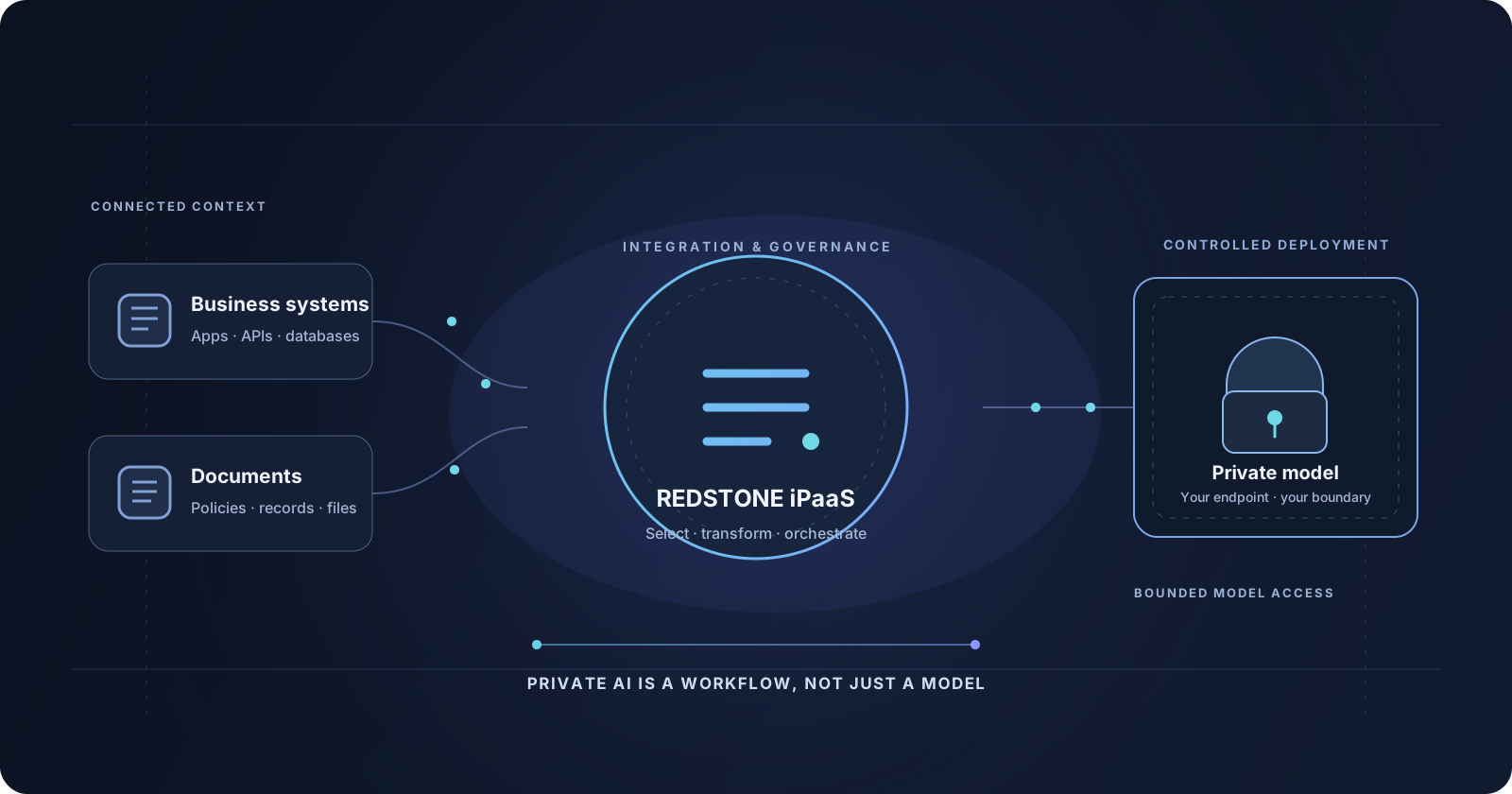
An AI assistant can draft a useful answer in seconds. But before that answer appears, a prompt may have crossed a network, a document may have been retrieved from a business system, and a suggested action may need to update a record somewhere else. Where did each piece of information go? Which identity accessed it? And can you explain what happened afterward?
Those are not model questions. They are questions about the whole workflow.
That is why private AI is more than choosing a model that runs in your data centre. The model matters, but so do the systems that supply it with context, the services it can call, and the controls around the complete journey. Redstone iPaaS helps teams connect those parts into a process they can deploy and govern on infrastructure they choose.
What “private AI” should mean
There is no single deployment pattern called private AI. For one organisation, it means using an enterprise model endpoint in a specific region. For another, it means hosting the model in its own cloud tenancy or on premises. A disconnected environment may need to keep the entire process inside a network with no external route at all.
The common requirement is control: control over which data is used, where it travels, who can access it, and how the work is recorded. The model’s location is one piece of that picture, not the whole definition.
Consider a model running on a server you own. If an application sends it customer records through an unapproved service, the overall workflow is not private just because the model is local. The reverse can also be true: a carefully configured enterprise endpoint may meet an organisation’s needs when its network, contractual and operational controls are appropriate.
The right question is therefore not only “Where does the model run?” It is also “What exactly reaches it, what can it do, and what happens to the result?”
The data path is the privacy boundary
An AI workflow commonly has several stages:
- A user asks a question or starts a process.
- The system retrieves relevant records or documents.
- Selected context is sent to a model.
- The model returns an answer or proposes an action.
- Another system may be updated, or a person may approve the next step.
- Logs and operational telemetry record enough information to understand the run.
Every stage can involve a different system, identity and network boundary. A document search service may hold sensitive content. An output may contain information that was not in the user’s original question. A logging system may retain prompts longer than expected. And a model response that looks plausible is not, by itself, an authorised business decision.
This is the integration challenge: private AI has to work with real data and processes without turning every connection into a one-off application. Teams need a deliberate way to select and transform information, call the model, apply business rules, and hand the result to the right system or person.
Where Redstone iPaaS fits
Redstone iPaaS 5.1 builds its AI capabilities on the unified AI abstractions in .NET 10. The model provider is configurable, so an organisation can point Redstone at a hosted provider, an in-region enterprise endpoint, or a model on its own hardware. Redstone can run headless on premises, in a customer-controlled cloud tenancy, or in a fully air-gapped environment. The deployment and the provider still need to be configured to match the network and data policies of the specific use case; the platform does not make those decisions for you.
That flexibility matters because integration work rarely starts with a blank slate. Business data already lives in applications, databases, document stores and APIs. Redstone workflows provide a place to connect the systems involved and define what should happen between them, rather than asking a model to become the integration layer.
Bring only the context the task needs
More context is not automatically better. An invoice-checking workflow, for example, might need the invoice fields, a supplier record and a short set of payment rules. It does not need to send an entire finance database to a model.
An integration workflow can shape and route the information before an AI step: select the relevant fields, retrieve the appropriate records, and send only the context required for the task. Redstone 5.1 also supports embeddings and vector search, which can help find relevant passages in documents already flowing through the platform. This makes meaning- based retrieval possible alongside ordinary business integrations.
Retrieval still needs thoughtful boundaries. Which documents are in scope? Does the search respect the user’s permissions? How fresh is the index? What information is returned to the model? These are design and configuration questions to answer for each deployment, not assumptions to leave to the AI.
Let workflows mediate actions
Giving an assistant direct access to a database is a very different risk from asking it to request a specific business action. Redstone workflows can be exposed as callable tools: the assistant can request an operation, while the workflow provides a governed place to validate inputs, apply process rules and control what the operation is allowed to change.
For example, an assistant might identify a possible duplicate invoice and ask a workflow to create a review task. The workflow can check required fields, preserve the original record, and route the case to an employee. The AI helps with the work; the process defines what actually happens.
Redstone’s existing middleware applies to AI calls too, including authentication, rate limits, logging and audit trails. That gives teams a path to make AI activity traceable alongside the rest of an integration. It does not replace access reviews or good workflow design, but it means AI need not be a separate, unobserved side channel.
Choose where the work runs
Some processes need an enterprise endpoint in a chosen region. Others have to run within an organisation’s own environment, or at a site with limited or no internet connectivity. Redstone supports on-premises and air-gapped operation, as well as deployment in a customer-controlled cloud tenancy. Its headless API and supported Windows and Linux targets give teams options for fitting the integration runtime into existing environments.
This is useful for more than data residency. It can help keep a process close to the systems it depends on, reduce unnecessary network hops, and make an edge or disconnected deployment possible. It also means the model, the workflow runtime and the data sources need not all be one indivisible service.
When an answer needs to appear interactively, Redstone supports streaming responses using server-sent events. That can make a form or application feel responsive while output is being generated. Streaming does not change the need to validate an answer before using it to make a consequential decision.
A practical example: reviewing an invoice exception
Imagine a finance team that receives invoices in several formats. Today, staff compare each invoice with supplier details and payment rules, then create a case when something looks unusual.
An AI-assisted version could start with an integration that extracts the fields needed for review. A workflow checks the supplier and retrieves the relevant policy passages. Only that selected context is sent to the configured model endpoint. The model can summarise the discrepancy and suggest a reason code. A second workflow validates the result and creates a review task for a person; it does not silently approve payment.
That flow separates responsibilities. Integrations gather and prepare information. Retrieval supplies relevant context. The model interprets and drafts. Workflow rules constrain the next action. A person retains authority where the business requires it. Operational records help the team understand the run.
The same approach applies to internal knowledge assistants, support triage, document classification and other processes where information is spread across systems. Start with a bounded task, define the data it needs, and make the model’s permitted actions explicit.
Make privacy a property of the whole system
Before putting a private AI workflow into production, map its data path from user request to final action. Identify the model endpoint, retrieval stores, integrations, logs and network connections. Decide which fields may be sent, how long results are retained, and which identities can invoke the workflow.
Then test the boundaries, not only the quality of the answer. Try a user without the expected permissions. Check that unrelated records are not retrieved. Confirm that outputs cannot bypass validation or approval. Review what operational logs contain, and test what happens when the model endpoint is unavailable or returns an unusable result.
Private AI does not mean “no risk,” and a private deployment does not by itself establish compliance. Model behaviour, data quality, access policy, infrastructure and human oversight remain important. Redstone provides integration and workflow capabilities for building the process; your team remains responsible for deciding which controls are appropriate and verifying them in its environment.
The benefit is a more useful choice than “AI everywhere” or “AI nowhere.” You can connect a specific task to a model that fits your requirements, keep the surrounding process within infrastructure you control, and give the model only a bounded role in the work.
If you are evaluating a private AI use case, start with the workflow rather than the model shortlist. Map the data, identify the systems involved, and decide what the AI may and may not do. Redstone iPaaS can help connect those systems and make the resulting process a managed part of your integration landscape. Talk to us about where your workflow needs to run and what you need it to connect.