
Long-term support is a promise to keep moving
When a system runs important parts of a business, choosing it is not a one-year decision. It needs to keep working as infrastructure changes, teams grow and the software underneath it reaches the end of its support life.
That is why we built Redstone around a simple commitment: customers should have one continuously maintained upgrade path, with up to ten years of Long Term Support across the journey. LTS does not mean pinning a customer to an old release and hoping it stays safe. It means maintaining the route forward, so customers can keep receiving supported platform and security updates without starting their systems over.
We learned what that requires by building Redstone through several generations.
Four generations, one product
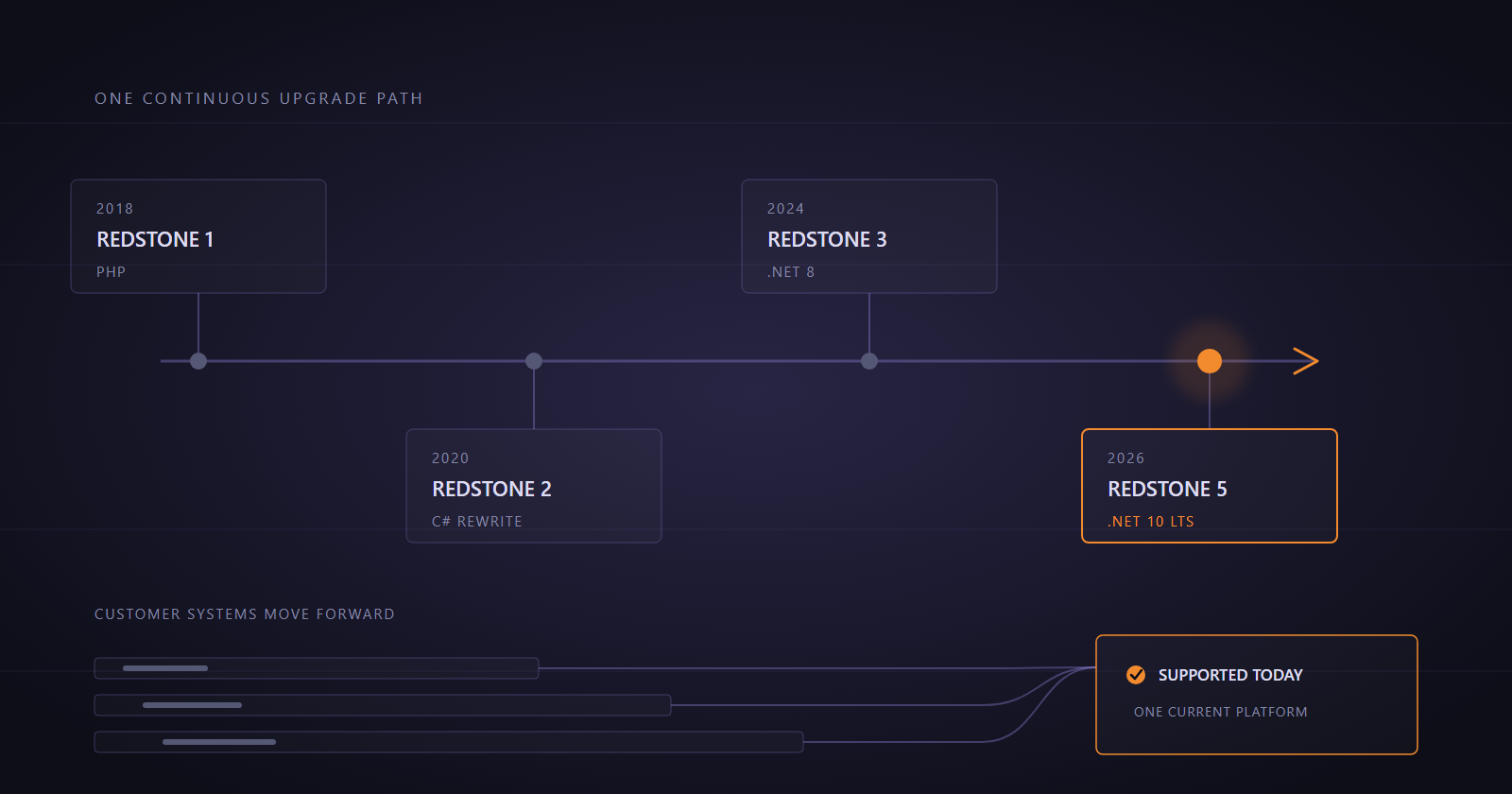
Redstone 1: the idea takes shape
Redstone began around May 2018, with its core written in PHP. It proved the idea: a platform that could connect systems and support real customer workflows. As adoption grew, though, so did the demands on the core. We needed to distribute Redstone more broadly and make it practical for multiple programmers to develop and maintain its shared code.
PHP had served the first stage well, but it was not the foundation we wanted for that next level of enterprise development. We chose C# and the .NET ecosystem as the basis for what came next.
Redstone 2: a necessary rewrite, not the destination
Redstone 2 arrived in 2020 as a rewrite of the PHP version in C#. It moved the platform in the right direction, but it did not last long. Rewriting a product in a new language is not, by itself, a long-term maintenance strategy. The structure of the code, the boundaries between its parts and the way a team can evolve it matter just as much.
That was an important lesson: a successful upgrade is not only about changing the runtime. It is about building a foundation that can be changed deliberately over time.
Redstone 3: engineering for the long run
In 2024, Redstone 3 brought a more considered C# architecture: reusable libraries, clear classes and code organised to be maintained by a team rather than carried by one person. Running on .NET 8, it also brought a substantial performance step forward.
In production testing, we have observed individual containers configured with one vCPU and 4 GB of RAM handling approximately 2,000 to 6,000 requests per minute. That is a measured result from our tested workloads, not a universal capacity guarantee: throughput depends on the workflow, request size, integrations and environment. It does show what a carefully built platform can do on modest infrastructure.
Redstone 5: the current platform
Redstone 5 is the next step in that same product journey. In 2026, we are working through the move of every customer, new and existing, to Redstone 5. Built on the current .NET generation and shaped by what we learned in the earlier releases, it gives customers a shared, modern foundation for the work they depend on.
The goal is not to ask customers to choose between progress and continuity. It is to deliver both: a more capable platform, with a planned and supported route from the Redstone they already run.
What our LTS commitment means in practice
Long-term support is not a promise that one build will remain unchanged for ten years. Frameworks, operating systems and security requirements move on; eventually, the responsible choice is to move with them. Our commitment is to maintain the upgrade path so that customers can move forward in supported steps.
- A maintained platform. We keep Redstone aligned with supported runtime generations and apply platform improvements along the way.
- A route forward for existing customers. Redstone 1, 2 and 3 customers are part of the move to Redstone 5, not stranded on separate product branches.
- Continuity for customer systems. The platform evolves underneath the business workflows built on it; an upgrade is not a reason to rebuild the business from scratch.
- A shared destination. New and long-standing customers converge on the same current platform, making maintenance and ongoing improvements more consistent.
This is how a product can serve customers over a long horizon without asking them to bet their future on an obsolete runtime or a frozen release.
Up to ten years, without standing still
The number matters less than the mechanism behind it. Our LTS commitment is backed by active engineering: keeping the core maintainable, moving Redstone through supported .NET versions and planning customer upgrades as part of the product lifecycle.
Redstone started as a PHP platform in 2018. It has been rewritten, re-architected and made faster, but the purpose has stayed consistent: give customers a dependable platform for the systems they need to run. With Redstone 5, we are bringing that journey together on one current foundation.
That is what Long Term Support should feel like from a customer's side: your system keeps moving forward, and you do not have to make the journey alone. To talk about the Redstone 5 upgrade for your environment, contact our team.