
No system is perfect. A data leak, a security breach, a serious software defect or an unavailable service can interrupt the way a business works. In those moments, the most useful question is not, "How could this possibly happen?" It is, "What do we know, who is affected, and what should we do next?"
That distinction matters. A complicated system has many moving parts, and no team can anticipate every combination of conditions, user behaviour and external change. The aim is not to promise that nothing will ever go wrong. The aim is to respond with care and discipline when it does: reduce harm, get the business back to business as usual (BAU), and learn enough to make a repeat less likely.
This is where a team matters. People bring different levels of experience and different views of the system. One person may recognise a technical signal; another may know how a customer workflow depends on it; someone else may ask the question the rest of the room has overlooked. Under pressure, that range of perspective is a practical advantage.
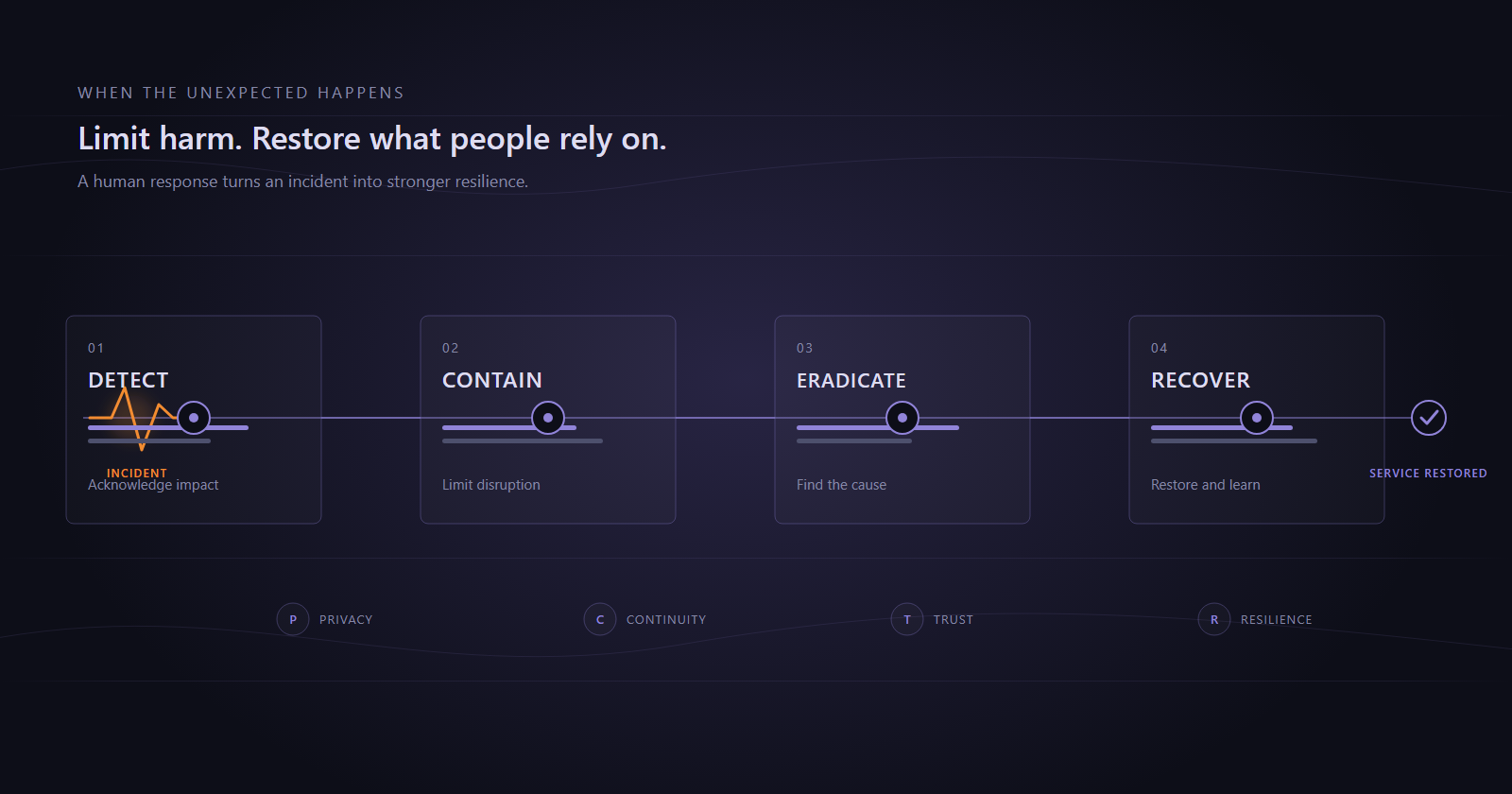
Our incident response follows four steps: Detection and Acknowledgment, Containment, Eradication and Root Cause Analysis, then Recovery and Lessons Learned. They are distinct phases, but an incident is rarely a perfectly tidy sequence. New information can send a team back to an earlier question. The structure is there to keep the response moving, not to force reality into a checklist.
1. Detection and acknowledgment
An incident response begins when a signal is taken seriously. That signal could be an alert, a report from a customer, an unexpected system behaviour or a security concern. At first, the team may not know whether it is looking at a brief interruption, a wider service problem or a potential exposure of data. It does not need certainty to begin responding. It needs to acknowledge the report and establish what is known.
The first useful actions are simple: capture what was observed, when it began, which service or workflow appears affected, and what evidence is available. Separate confirmed facts from assumptions. If a customer cannot complete a critical task, that impact deserves attention even while the underlying technical cause is still unclear.
Acknowledgment also means making sure the right people are engaged. Technical responders need to investigate the system. People responsible for the affected business process can explain what interruption means in practice. When security or sensitive information may be involved, that concern should be visible early rather than waiting for a routine software investigation to finish.
Clear communication starts here. Say that the issue is being investigated, describe the known impact, and avoid guessing at a cause or promising a resolution time without evidence. Honest uncertainty is more useful than confident misinformation.
2. Containment: immediate response
Once the team understands enough to act, the priority is to limit ongoing impact. Containment is not necessarily a fix. It is a deliberate step to stop a problem from spreading or continuing while the team investigates.
Depending on the situation, that might mean temporarily disabling an affected function, restricting access, isolating a component, pausing a deployment or switching to an established fallback. The right action depends on the risk and the business workflow. A measure that protects one system but unnecessarily blocks every user may create a second incident of its own.
This is where different experience levels help again. Someone close to the code may see a technical option; an operator may know how it will affect dependencies; a colleague with less familiarity may ask whether the proposed action is reversible or whether it creates a new risk. The team should make the trade-off explicit: what harm are we trying to prevent, what will this action interrupt, and how will we know whether it worked?
Keep a record of decisions and changes as they happen. During a fast response, a short timeline helps everyone stay aligned and gives the investigation reliable facts later. Containment should be proportionate, communicated to the people who need to know, and reviewed as new evidence arrives.
3. Eradication and root cause analysis
With the immediate impact controlled, the team can work towards removing the cause. That means more than treating the visible symptom. Restarting a service may restore it temporarily; it does not explain why it stopped. Reverting a release may return a workflow to service; it does not by itself show why the change failed under real conditions.
Root cause analysis looks at the conditions that allowed the incident to occur and the safeguards that did not catch it sooner. There may not be one neat cause. A defect, an unexpected input, a configuration choice and a missing check can combine into an outcome that none of them would produce alone.
The investigation should be blameless, not consequence-free. Blameless means we focus on evidence, decisions, system conditions and opportunities to improve rather than searching for a person to punish. People still own their actions, and the organisation still has to address risk. But fear makes people hide useful information; curiosity helps the team find it.
The questions are practical: What changed? What did the system do? What did people expect it to do? Which assumptions proved false? What made the issue hard to detect or contain? The answers inform the corrective work, whether that is a code change, a configuration update, a clearer operational procedure or an additional test.
4. Recovery and lessons learned
Recovery means returning the affected service and business process to a stable state, not just seeing a green dashboard. The team should verify the fix, check the workflows that matter, and watch for signs that the issue is recurring. If the incident involved data or security, recovery also includes understanding the scope and following the appropriate communication and response obligations.
Business as usual may return in stages. A workaround can restore an essential task while a more complete repair is still being validated. Be clear about what is working, what remains limited and what users should do. Trust is built by keeping people informed, not by pretending a partial recovery is complete.
Afterwards, make the lessons concrete. Record what happened, what reduced the impact, what slowed the response, and what should change. Turn the findings into actions with an owner and a way to check completion. A lesson that lives only in a meeting summary is easy to forget; a test, an alert, a reviewed procedure or an improved fallback becomes part of how the system works next time.
The stakes reach beyond the system
These steps matter beyond a status page. Digital systems support payments, education, logistics and public services; disruption can cut off money, information, supplies or income. Detection clarifies who is affected; containment limits exposure or interruption; root-cause work addresses conditions, not just symptoms; recovery restores workflows; lessons reduce recurrence. Incident response cannot solve every challenge. It can prevent technical failure from adding avoidable harm and help keep important services dependable.
There is no bug-free system. A team that listens, draws on different experience, shares facts and learns can limit damage and strengthen resilience. That is how a disruption becomes a stronger way of working.